

RubyRed challenges faced head-on RubyRed正面面临挑战
As red kiwifruit finds favour with consumers, researchers are tackling any issues the variety still presents.随着红猕猴桃受到消费者的青睐,研究人员正在解决该品种仍然存在的任何问题。
Tray volumes of RubyRed kiwifruit are set to double this season as consumers develop a taste for the red variety, with Zespri and the Kiwifruit Breeding Centre committed to resolving some of the challenges the fruit continues to present to growers.
The latest kiwifruit cultivar in Zespri’s portfolio has been in development for over 20 years and has been well received in markets it has reached.
But, while its berry-like flavour is highly palatable, growers have faced issues with smaller fruit size, lower yields per hectare, and susceptibility to Psa in certain areas. Additionally, its shorter shelf life limits its export to closer Asian markets.
The Kiwifruit Breeding Centre, jointly owned by Plant and Food Research and Zespri and based in Te Puke, is the hub for resolving some of those issues.
The centre’s chief commercial officer, Dr Bart Challis, said unlike SunGold, which followed a direct cultivar-to-concept approach, RubyRed may evolve through multiple cultivars.
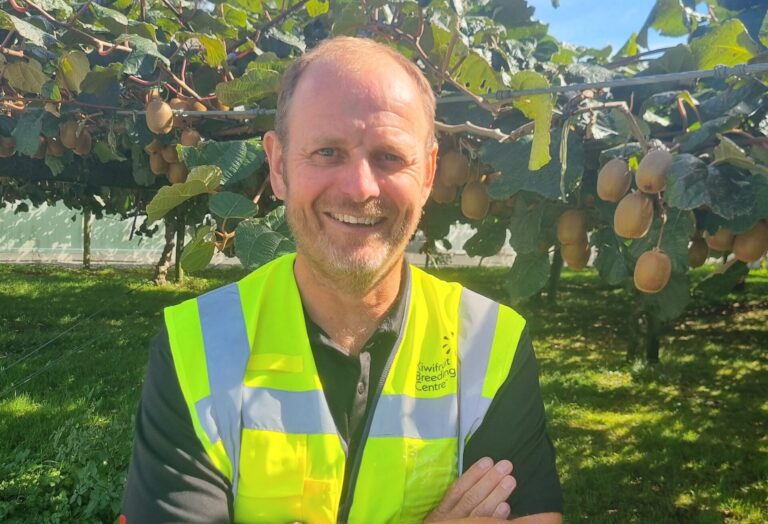
▲Rather than a one cultivar, one fruit, Dr Bart Challis of the Kiwifruit Breeding Centre says RubyRed’s solution may involve at least two cultivars. Photo: Supplied
随着消费者对红色猕猴桃的喜爱,本季RubyRed猕猴桃的托盘量将翻一番,Zespri和猕猴桃育种中心致力于解决这种水果继续给种植者带来的一些挑战。
Zespri产品组合中的最新猕猴桃品种已经开发了20多年,在其所覆盖的市场上广受欢迎。
但是,虽然其浆果般的味道非常可口,但种植者面临着水果尺寸较小、每公顷产量较低以及在某些地区易受Psa影响的问题。此外,其较短的保质期限制了其向更接近的亚洲市场的出口。
Kiwifruit育种中心由植物与食品研究公司和Zespri共同拥有,位于特普克,是解决其中一些问题的中心。
该中心的首席商务官Bart Challis博士表示,与遵循直接品种到概念方法的SunGold不同,RubyRed可能会通过多种品种进化。
“We run a continuous pipeline of cultivars, selecting from additional red varieties to make incremental improvements.”
In November, Zespri CEO Jason Te Brake reaffirmed the company’s commitment to RubyRed, despite sizing and storage challenges.
He highlighted ongoing trials for a new cultivar with the potential to extend the shipping and retail window beyond eight weeks, complementing the current variety. With accelerated assessment, commercial availability could be possible within two years.

▲刚完成授粉的红心猕猴桃幼果
“我们经营着一个连续的品种管道,从额外的红色品种中进行选择,以进行渐进式的改进。”
11月,Zespri首席执行官Jason Te Brake重申了公司对RubyRed的承诺,尽管存在规模和存储方面的挑战。
他强调了正在进行的一种新品种的试验,该品种有可能将运输和零售窗口延长到八周以上,以补充目前的品种。通过加速评估,商业可用性可能在两年内实现。
Challis said Psa’s emergence in 2010 meant breeders had to reset their breeding plan and incorporate greater Psa tolerance, delaying RubyRed’s commercial release.
The disease remains a significant challenge, prompting Zespri’s grower and industry engagement officer Tracy McCarthy to stress the importance of farm and sheltered sites for improved resistance.

▲Kiwi young fruit
“In partnership with growers, we have developed many management tools that work well on Red19 (RubyRed),” she said.
Challis believes RubyRed’s Psa tolerance has advanced beyond that of the varieties of competitors overseas.
Meantime, Zespri has temporarily suspended issuing new licensed areas for the fruit, pending an announcement in its five-year outlook plan later this year.
Finding the right balance for the fruit cultivar remains a priority to meet the needs of growers, consumers and the supply chain.
“That supply chain component is very much a New Zealand Inc issue, due to our distance to market,” Challis said.
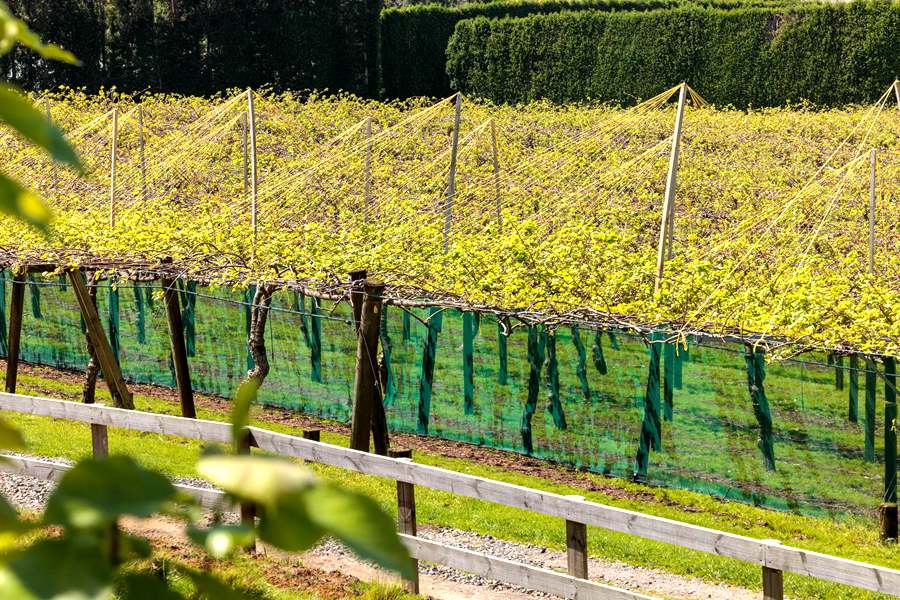
▲新西兰高枝牵引猕猴桃果园照片
“There’s no point in developing a fruit with great consumer appeal unless it can be delivered in good condition.”
He noted that relying on controlled atmosphere storage to extend shipping life affects profitability, compared to breeding storage quality directly into the fruit. However, Zespri’s Global Supply agreements in the northern hemisphere could help address some of the distance challenge.
Growers have also raised concerns about RubyRed’s size – it is considerably smaller than SunGold and Green.
Challis hopes the pre-commercial trials of the new cultivar will provide more clarity on larger size potential.
With gene editing legislation now getting a government hearing, the technology could also prove a tool to help iron out some of the fruit’s issues.

▲Using a new lithium battery kiwi pollination machine
Challis说,2010年Psa的出现意味着育种者必须重新制定繁殖计划,并纳入更大的Psa耐受性,从而推迟了RubyRed的商业发布。
这种疾病仍然是一个重大挑战,促使Zespri的种植者和行业参与官员Tracy McCarthy强调了农场和庇护场所对提高抗性的重要性。
她说:“我们与种植者合作,开发了许多在Red19(RubyRed)上运行良好的管理工具。”。
Challis认为,RubyRed的Psa耐受性已经超越了海外竞争对手的品种。
与此同时,Zespri已暂停为该水果发放新的许可区域,等待今年晚些时候在其五年展望计划中公布。
为水果品种找到适当的平衡仍然是满足种植者、消费者和供应链需求的首要任务。
Challis表示:“由于我们与市场的距离遥远,供应链部分在很大程度上是新西兰公司的问题。”。
“除非能够完好无损地交付,否则开发一种具有巨大消费者吸引力的水果是没有意义的。”
他指出,相较于将贮藏品质直接培育成果实,依靠可控气氛储存来延长运输寿命会影响盈利能力。然而,Zespri在北半球的全球供应协议可能有助于解决一些距离挑战。
种植者也对RubyRed的规模表示担忧——它比SunGold和Green小得多。
Challis希望新品种的商业前试验将为更大尺寸的潜力提供更多清晰度。
随着基因编辑立法现在正在政府听证会上,这项技术也可能被证明是一种帮助解决水果问题的工具。

▲Red heart kiwifruit orchard in Sichuan Province, China
Zespri and the centre support precision breeding tools in principle, but not gene modification that transfers genes between species.
Challis said the tech is also no silver bullet and in the context of a 25-year breeding cycle the timelines are still considerable when employing it.
In response to claims that RubyRed struggles to crop with volume, he pointed to evidence that growers consistently achieve higher yields than trial crops.
Farmers Weekly confirmed some growers have exceeded 13,000 trays per hectare through strong cropping and management practices.
With over 50,000 hectares of red kiwifruit grown globally, particularly in China, a red kiwifruit’s place in consumer fruit bowls is well established.
“And RubyRed is commanding a very good premium despite global competition,” Challis said.

▲helping growers achieve their ultimate pollination
Zespri和该中心原则上支持精准育种工具,但不支持在物种之间转移基因的基因改造。
Challis说,这项技术也不是灵丹妙药,在25年的繁殖周期内,使用它的时间仍然很长。
针对RubyRed难以大量种植的说法,他指出有证据表明,种植者一直比试验作物获得更高的产量。
《农民周刊》证实,通过强有力的种植和管理措施,一些种植者每公顷的托盘数已超过13000个。
全球种植了5万多公顷的红猕猴桃,特别是在中国,红猕猴桃在消费者水果碗中的地位已经确立。
Challis表示:“尽管面临全球竞争,RubyRed的溢价仍然很高。”。

▲红心猕猴桃种植


评论